
11 Walkways to Front Door Landscaping Ideas That Make Your Home Look Welcoming
The front of a house is one of those things people drive past every single day without really seeing it until one afternoon the light hits differently and suddenly it looks kind of sad and uninviting.
Most of the time it is not the house itself that is the problem — it is the path leading up to it, which is either a plain concrete strip or barely there at all.
The walkway to the front door does more work than people give it credit for, because it is literally the first thing guiding anyone toward the home before they even notice the door color or the porch.
The good news is that most of these ideas do not require a landscaping crew or a budget that takes months to recover from.
Some of the most welcoming front entries come from pretty simple decisions — materials, edges, a little greenery — and this is a list of the ones that actually hold up in real life.
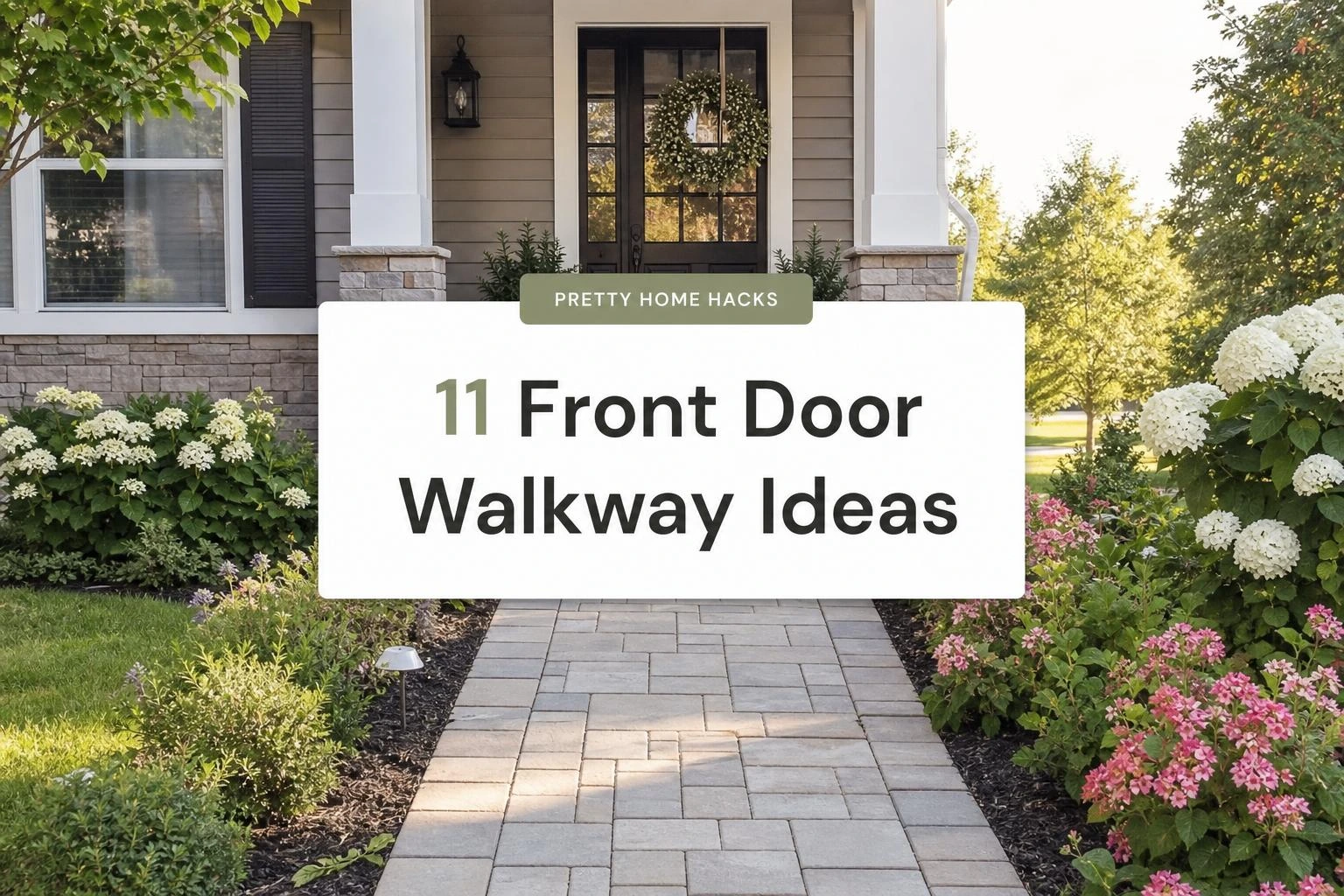
1- Curved Paver Path With Low Border Plantings
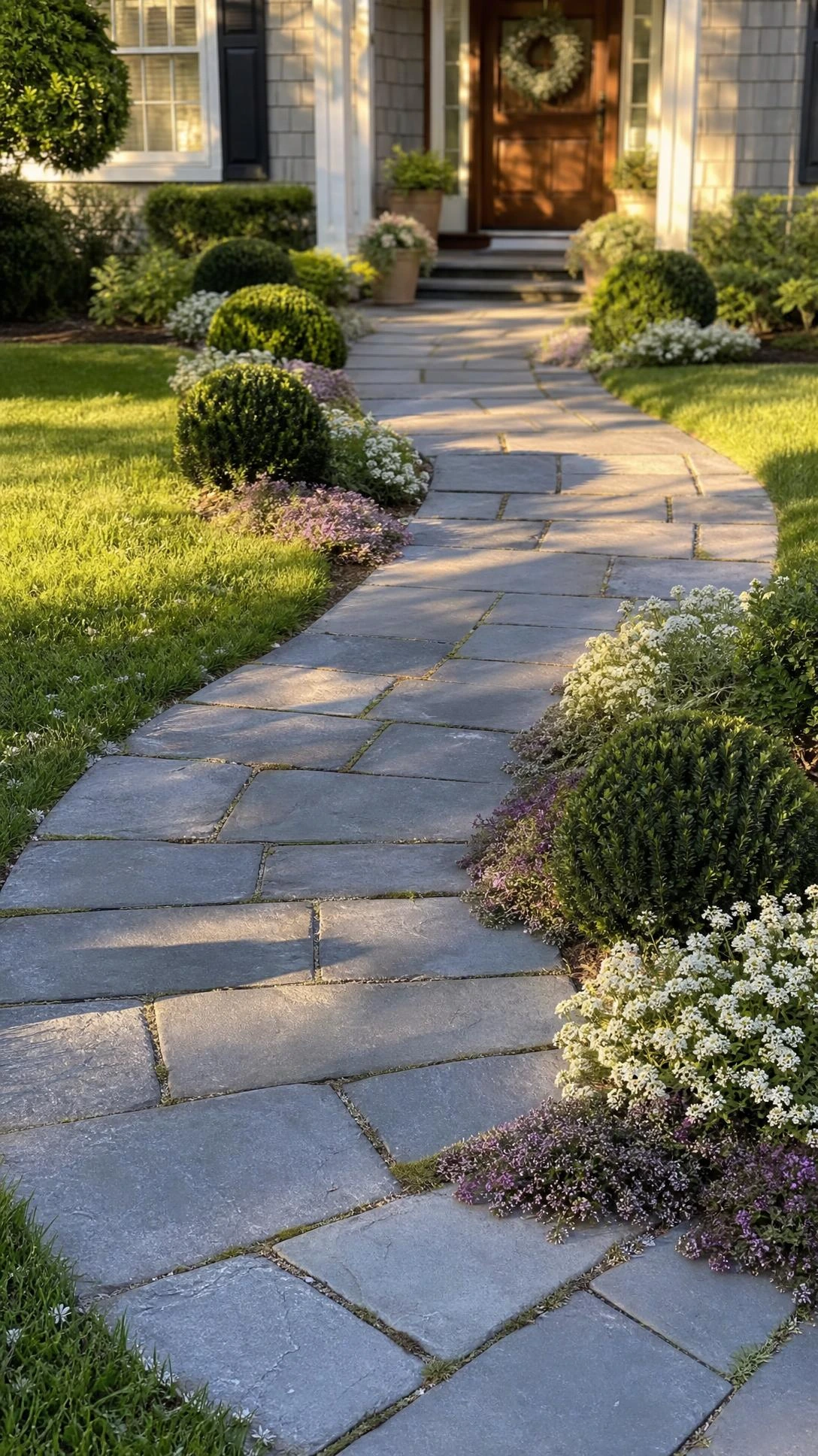
A straight concrete strip from the driveway to the front door is fine, but a gently curved paver path is the difference between functional and actually inviting.
The curve does not need to be dramatic — even a soft 10 to 15 degree arc away from a perfectly straight line gives the approach a more relaxed, resort-like feel.
Buff or sandstone-colored concrete pavers work especially well here because they warm up the whole front of the house without competing with brick or painted siding.
Lining both sides with low border plants like creeping thyme, dwarf mondo grass, or blue fescue keeps the edges soft without requiring much upkeep once established.
This is one of those combinations that looks like a lot of thought went into it even though the actual decision is pretty simple.
2- Brick Walkway With Symmetrical Garden Beds
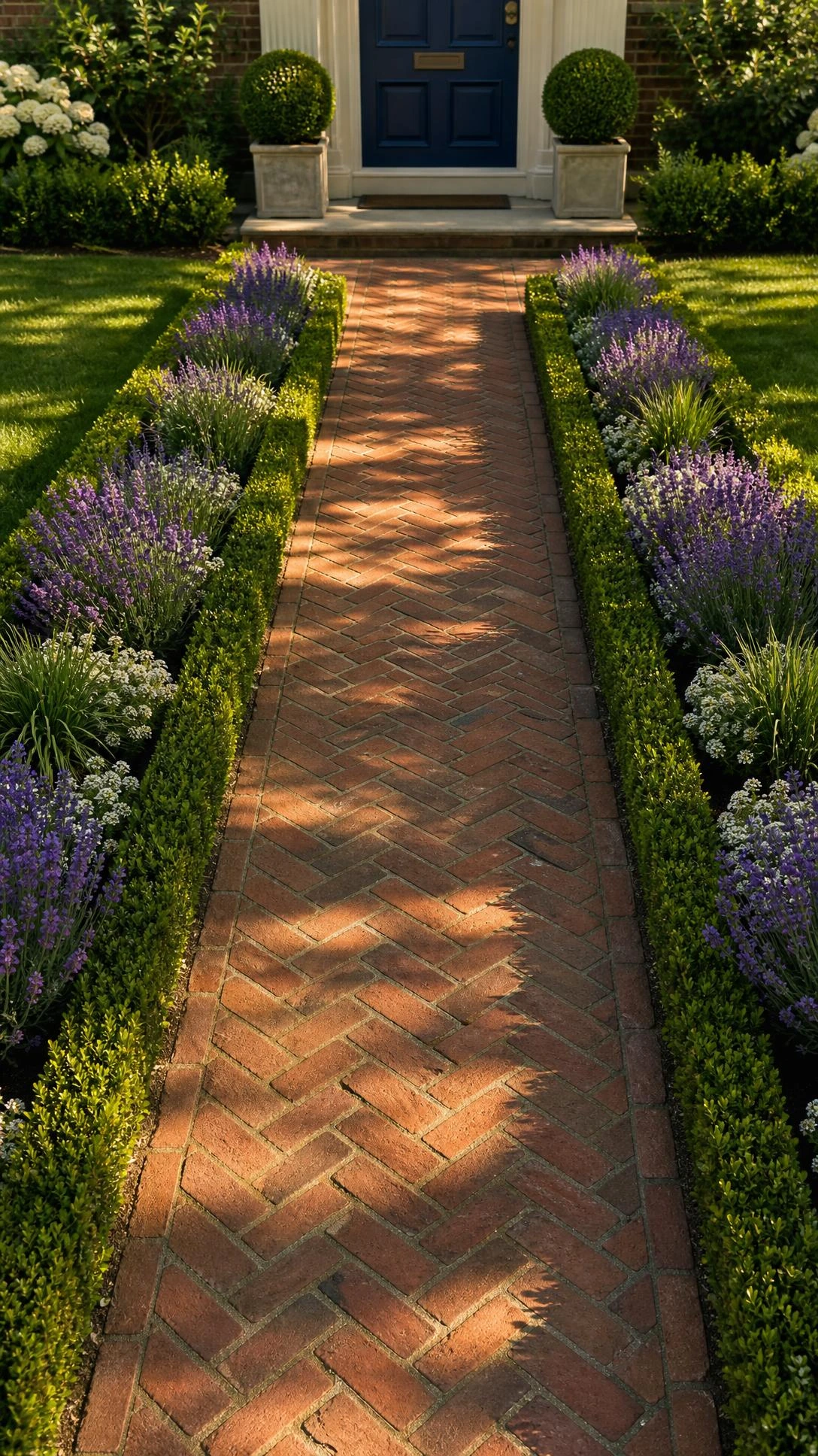
Brick is one of those materials that already looks like it belongs somewhere nice, which is exactly why it works so well for a front walkway.
A running bond or herringbone pattern in classic red or tumbled clay brick gives the path a timeless settled quality that poured concrete just cannot replicate.
The symmetrical garden beds on either side are what pull the whole look together — matching boxwood spheres about 18 inches wide placed at even intervals are the classic choice for a reason.
Brick can shift slightly over time if the sand base underneath is not packed well, so it is worth doing that part carefully or having someone who knows what they are doing handle the base prep.
Once it is in, a brick walkway basically takes care of itself, which is always a nice surprise given how polished the finished result looks.
3- Flagstone Path Through a Cottage Garden
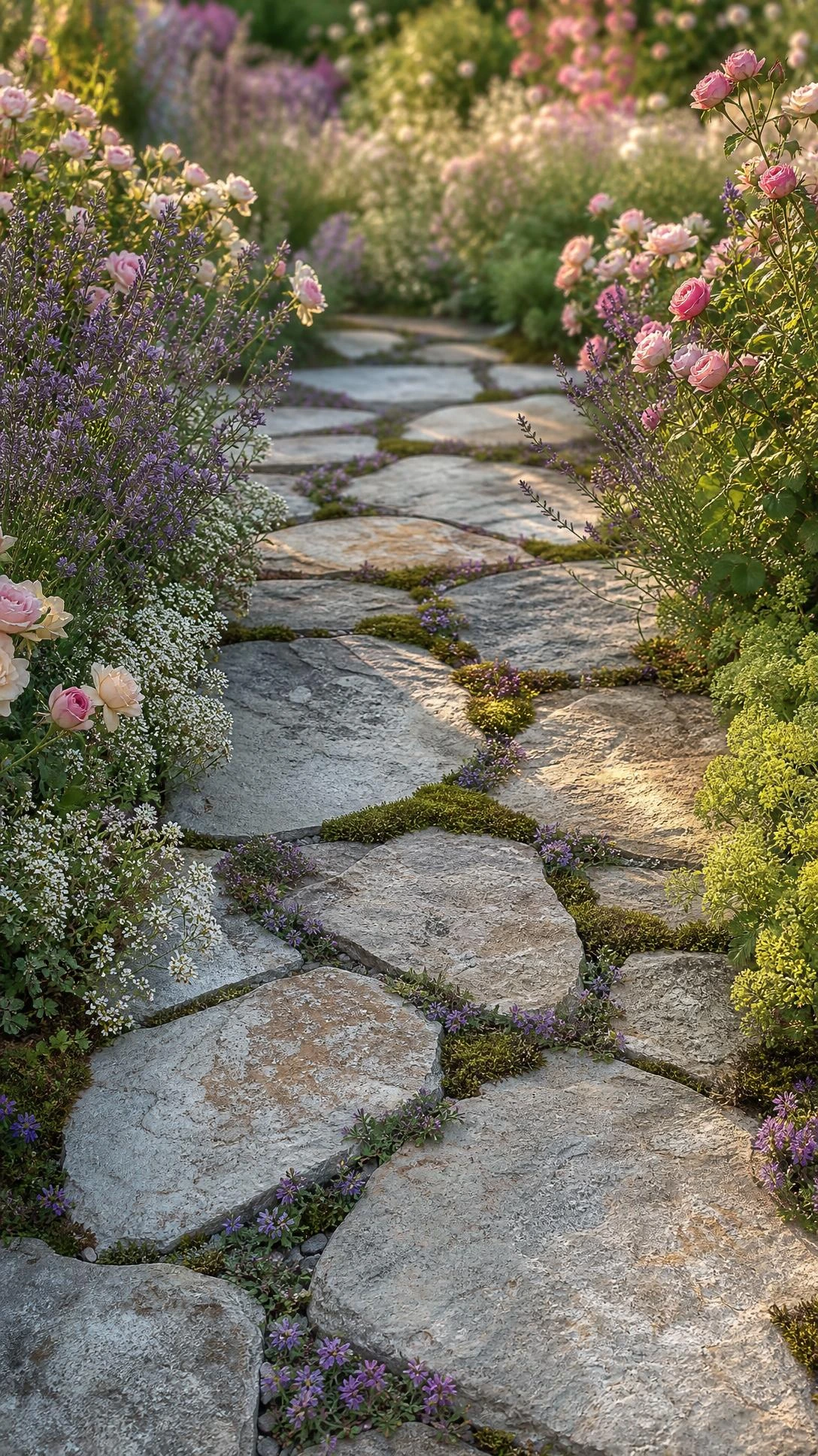
Flagstone paths through loose, planted gardens are the ones that feel genuinely lived-in rather than staged for a real estate photo.
The stones themselves are irregular, and that irregularity is the whole point — they look like they were placed by someone who took their time rather than a machine that did not.
Blue-gray Pennsylvania bluestone or earthy tan Arizona flagstone both work beautifully here, usually running about 3 to 6 dollars per square foot depending on the source.
The plants filling in around the stones are what make a cottage path feel full — lavender, catmint, salvia, and low ornamental grasses all spill over edges in a way that softens the whole entry.
This style works best on properties with a little yard depth on either side of the path so there is room for the planting to actually breathe and do its thing.
4- Modern Large-Format Concrete Pavers
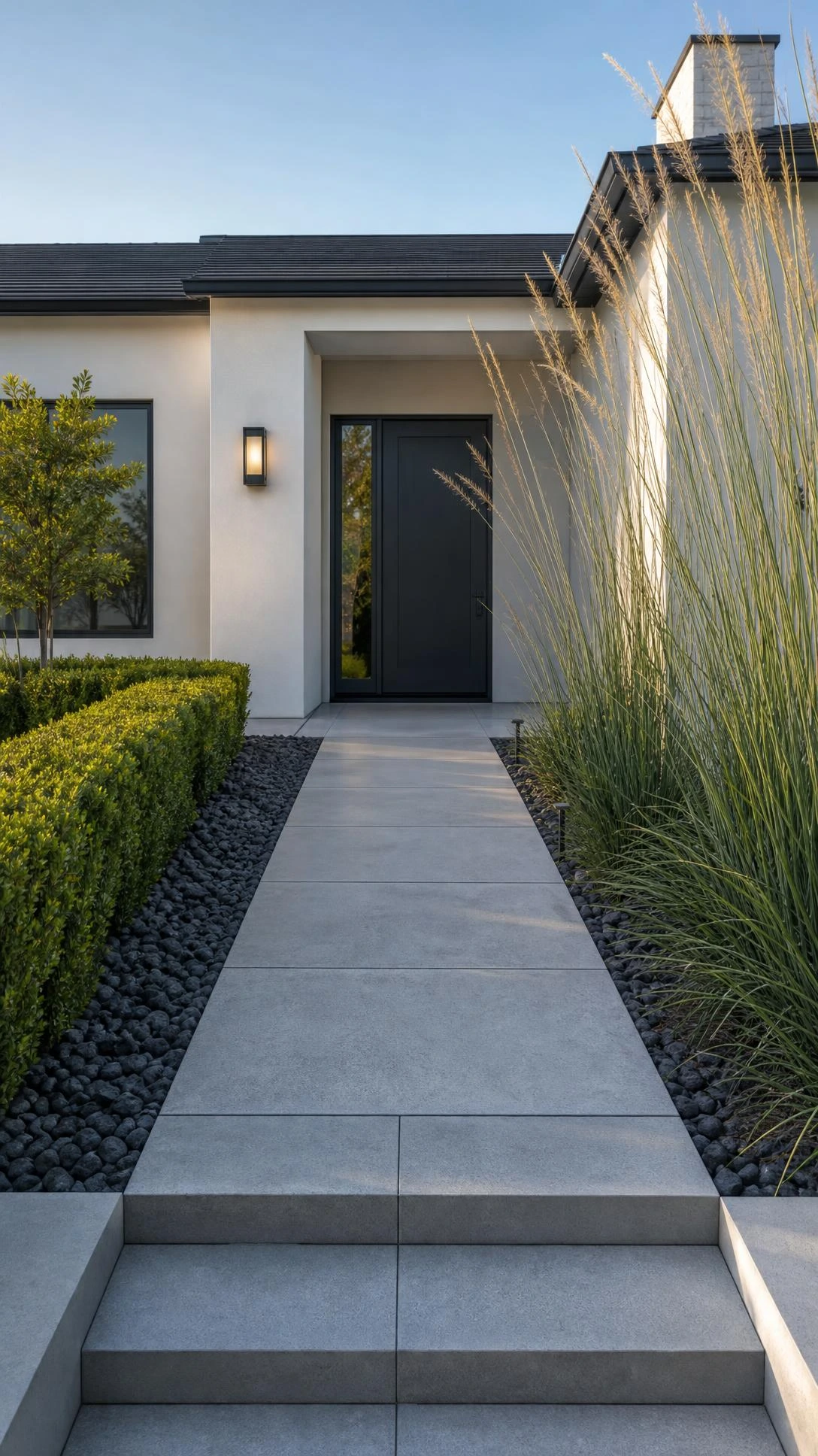
For houses with cleaner architectural lines, big flat pavers spaced with ground cover between them read as intentional and modern in a way that smaller pavers just do not.
Pavers in the 24 by 24 inch or 18 by 36 inch range, usually in charcoal, slate gray, or warm white, are what most people are saving on Pinterest when they search for a modern front entry.
The gaps between the pavers are usually filled with Irish moss, Corsican mint, or fine gravel — and I think the moss option is the most satisfying because it fills in slowly and ends up looking like it was always there.
The discipline in the planting matters just as much as the pavers themselves, because modern entries fall apart quickly when the surrounding beds get messy or overgrown.
A few architectural grasses like Karl Foerster feather reed grass flanking the front door keep the whole look grounded without overcomplicating it.
5- Gravel Path With Defined Metal Edging
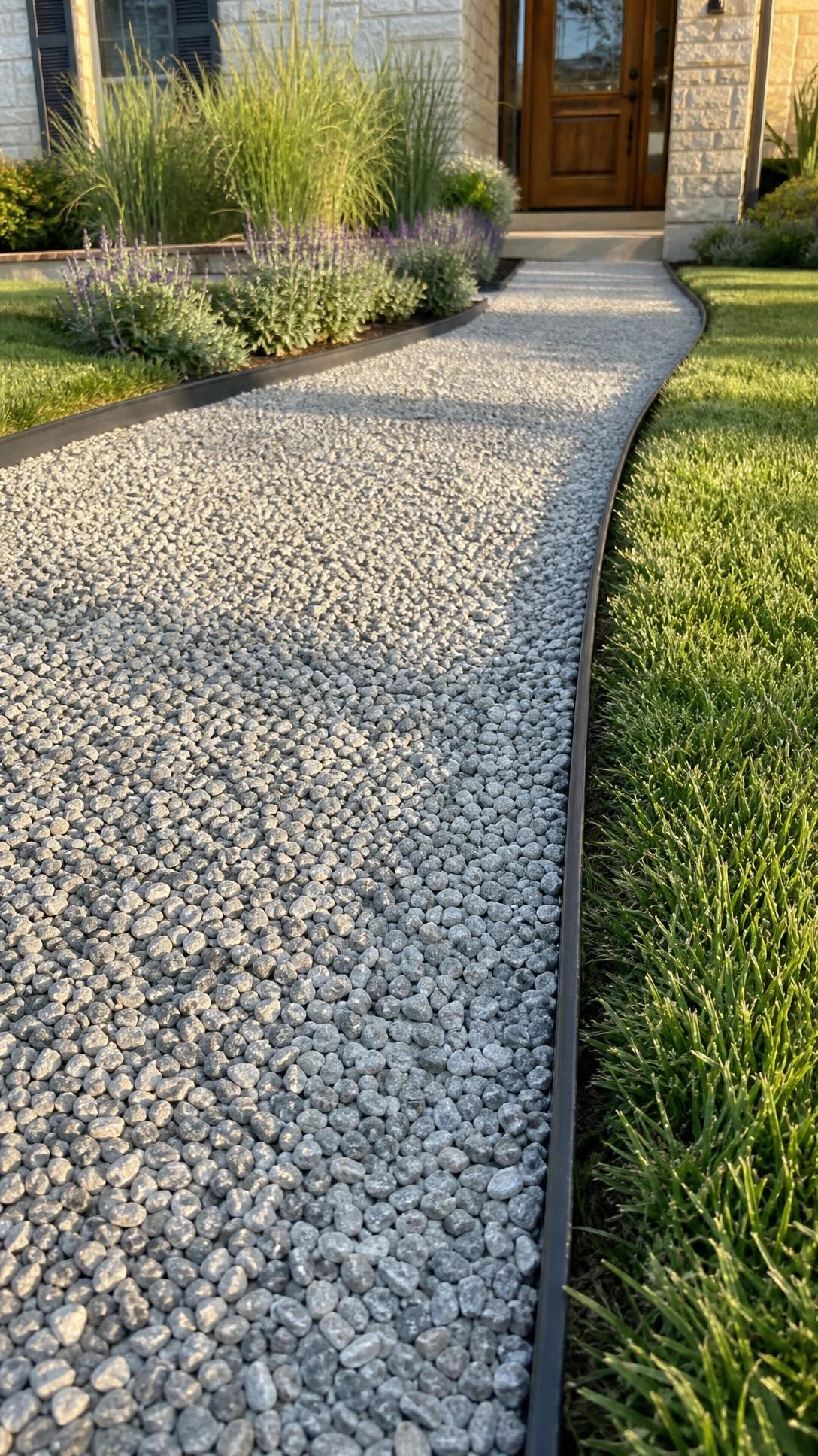
Gravel paths get dismissed sometimes as a budget move, but when they are done with good edging and the right gravel size they look completely intentional and actually quite sharp.
Pea gravel and decomposed granite are the most common choices — pea gravel in the 3/8 inch size tends to stay put better and crunch underfoot in a satisfying way that people seem to enjoy more than they expect.
Steel or corten edging in a 3 to 4 inch depth keeps the gravel from migrating into the lawn or garden beds, which is honestly the thing that makes or breaks a gravel path long-term.
Planting ornamental grasses or drought-tolerant shrubs like Russian sage along the sides adds just enough structure to make the whole entry feel finished rather than temporary.
This is a solid option for front yards in dry climates where other materials can heave or crack with the seasonal temperature swings.
6- Winding Stepping Stone Path With Ground Cover
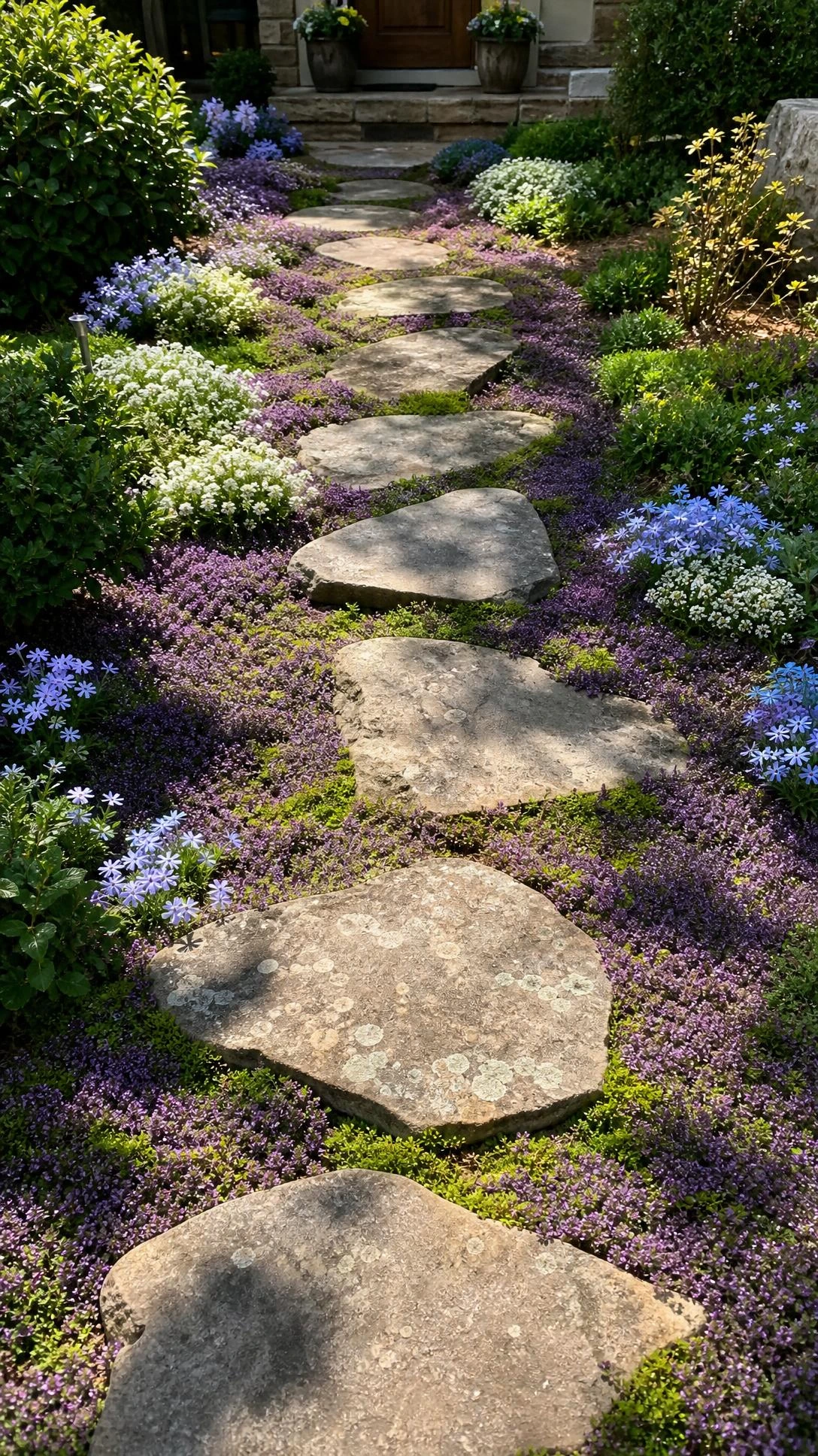
A winding stepping stone path gives a front yard a meandering, unhurried quality that feels welcoming before anyone even reaches the door.
Concrete stepping stones in a natural charcoal or aged finish laid about 18 to 20 inches apart on center match a comfortable walking stride so the path actually functions well, not just looks good in photos.
Planting creeping thyme or woolly thyme between and around the stones is the detail that takes this from plain to really charming — it releases a faint herby scent when brushed against, which is one of those small details visitors notice without knowing why they notice it.
This works best in front yards with a slightly informal or cottage-style house rather than something very angular and modern, where it can look a little out of place.
The whole setup is also relatively forgiving to install on a weekend without professional help, which is why it is one of the more popular DIY front walkway ideas out there.
7- Stamped Concrete With Landscape Lighting
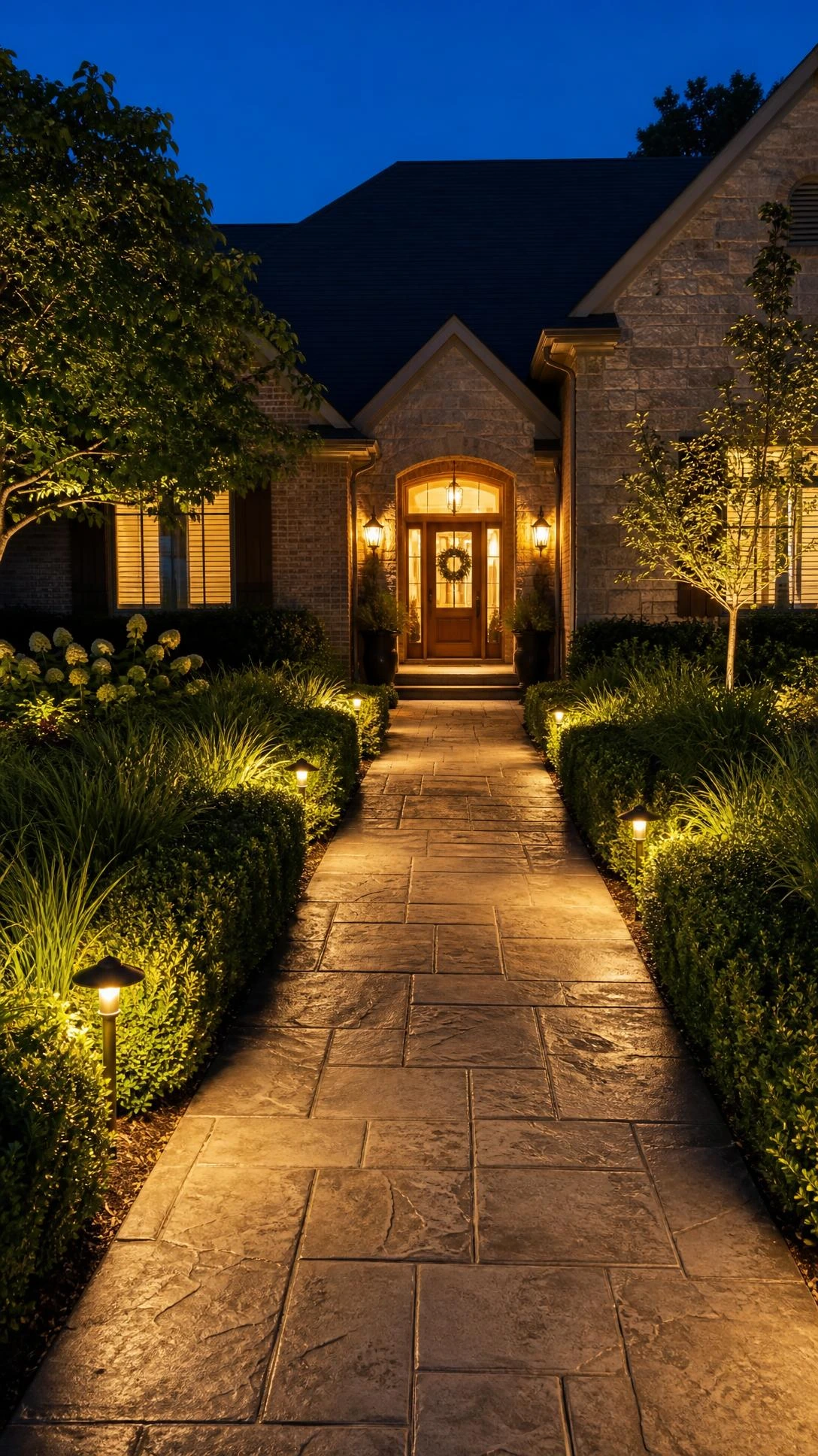
Stamped concrete is one of those options that nobody talks about as much as it deserves because it gives the look of stone or brick at a lower material cost once the labor is done.
An ashlar slate or cobblestone pattern in a warm buff or light gray tone blends with almost any house exterior and holds up well in most climates when sealed properly every two to three years.
Adding low-voltage landscape lighting along the edges — either in-ground path lights or small bollard lights staked into the border beds — changes the whole feel of the entry at night in a way that daytime photos never quite capture.
Solar-powered path lights in the 15 to 30 dollar range are an easy starting point, though hardwired low-voltage systems look cleaner and stay brighter throughout the evening.
This combination of surface detail and lighting is one of the more complete-looking entry setups without requiring a landscape designer to pull it off.
8- Boxwood-Lined Formal Entry Walkway
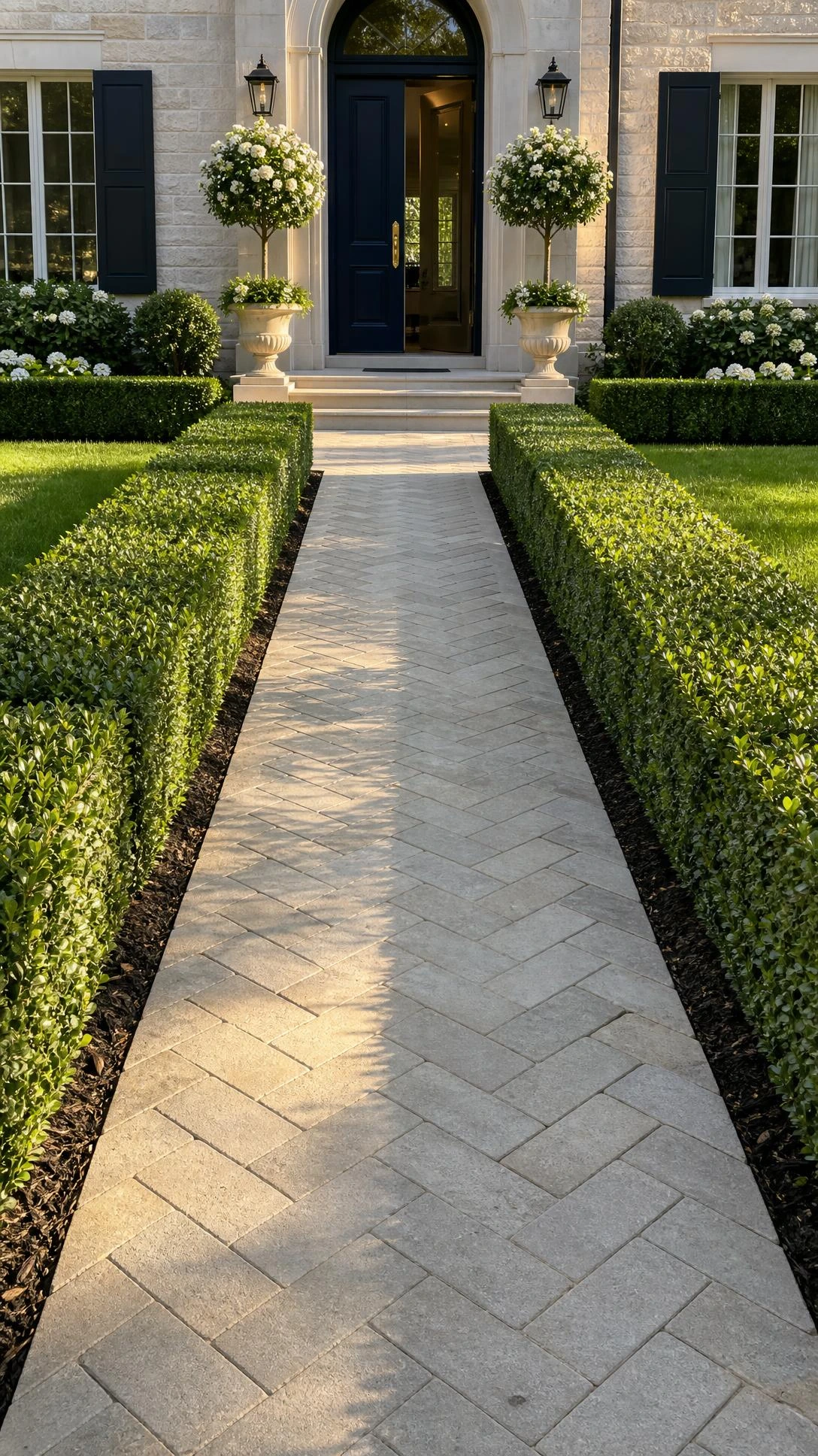
A formal walkway lined with matching boxwood hedges is one of those classic front entry looks that has lasted because it genuinely works on a lot of different house styles.
The key is keeping the boxwood trimmed consistently — two or three light trims per season is enough to maintain a tidy shape, and the difference between a trimmed and untrimmed boxwood hedge is not subtle.
Green Mountain boxwood stays a rich green through most winters and reaches a manageable 3 to 5 feet if left unpruned, which is a good size reference for anyone planning the spacing.
A concrete or bluestone center path between the hedges finishes the look, and this entry style particularly suits colonial, craftsman, or traditional-style homes where a little formality feels appropriate rather than stiff.
It is one of those setups where the upkeep is predictable and the payoff in curb appeal is consistent year after year.
9- Native Plant Borders Along a Simple Stone Path
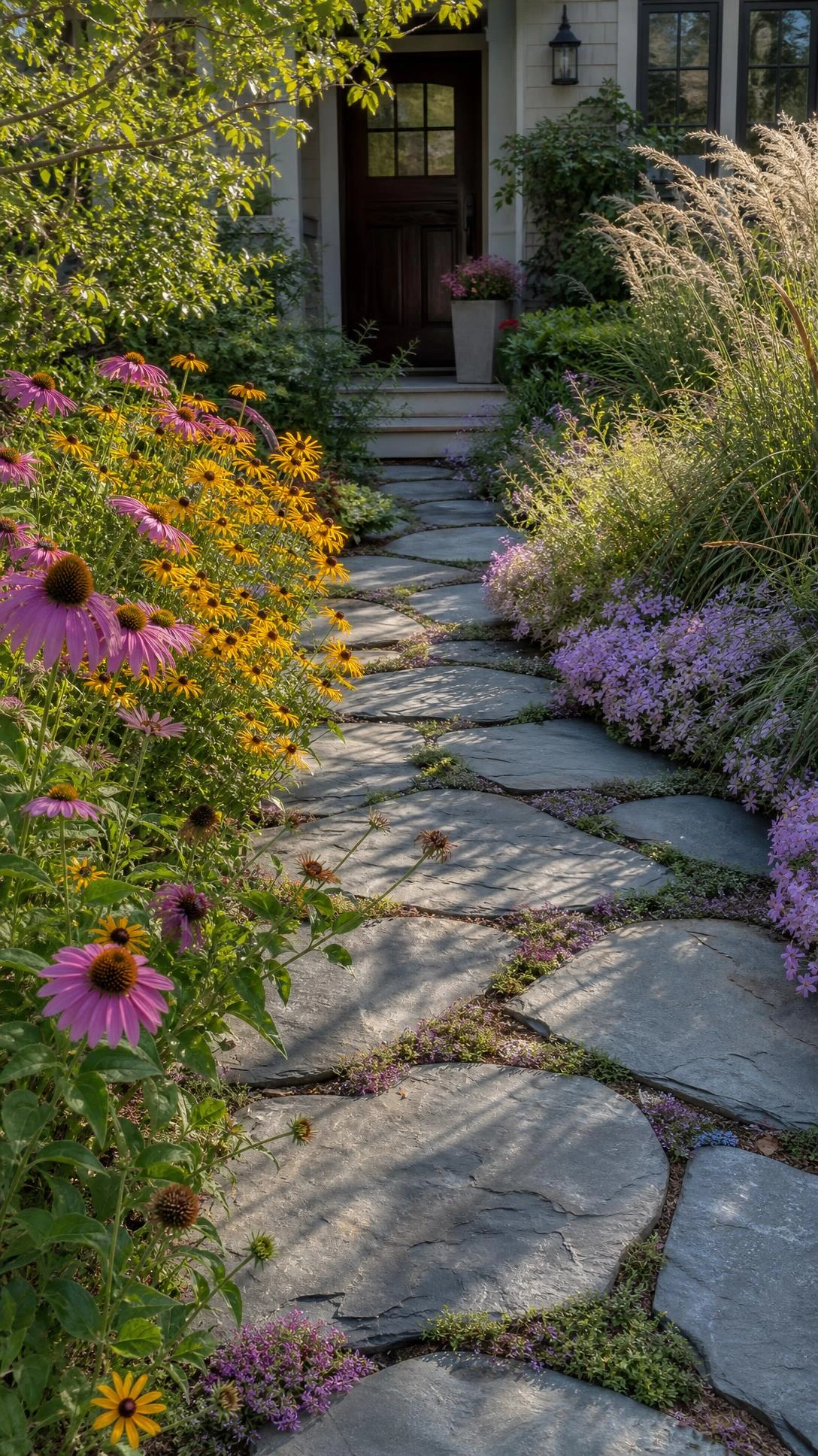
Using native plants along a front walkway is one of those decisions that looks thoughtful and actually is thoughtful, because plants adapted to the local climate tend to need very little intervention once they are settled.
A simple dry-stack stone or concrete paver path down the center with coneflowers, black-eyed Susans, little bluestem grass, and native salvia filling in alongside it gives the entry a natural relaxed look that still feels intentional.
This kind of planting also brings in pollinators through the warmer months, which adds a layer of life to the front of the house that a plain mulched bed never does.
The one thing to plan for is that native plantings can look a little untidy in early spring before they fill back out, so planting a few early-season bulbs like allium or tulip in between helps bridge that gap.
Most native plants establish well within one full growing season, and after that the maintenance drops off considerably compared to traditional ornamental beds.
10- Raised Planter Beds Flanking a Brick or Concrete Walk
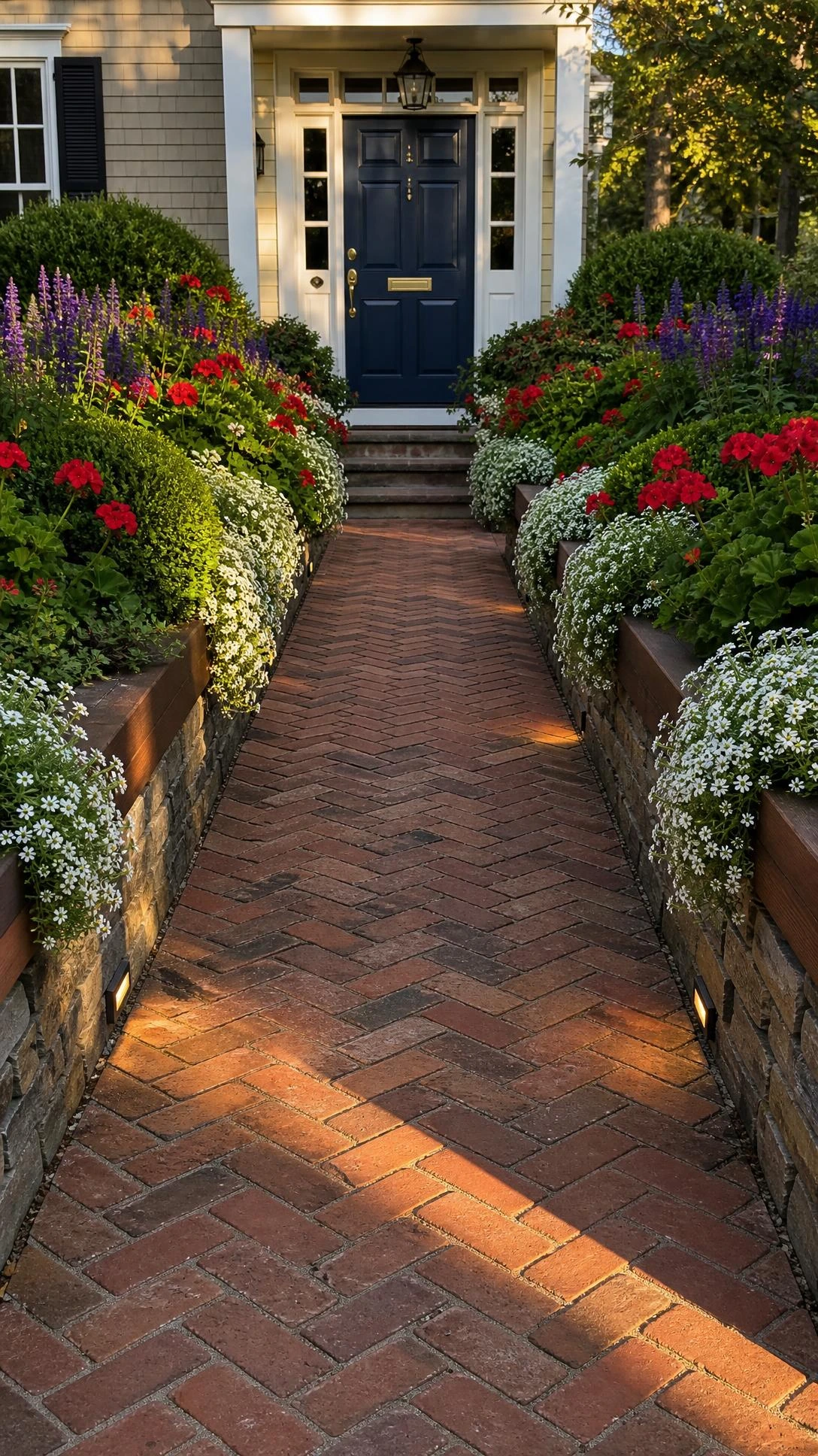
Raised planter beds on either side of a front walkway add a sense of height and architecture to a flat, open entry that can otherwise feel a little underwhelming.
Concrete block, natural stone, or cedar raised beds in the 12 to 18 inch height range are enough to create visual interest without blocking sightlines to the house or the front door.
Planting each bed with a combination of a taller ornamental grass or dwarf shrub in the center and trailing plants like calibrachoa or sweet potato vine along the edges creates a layered look that keeps the entry interesting from spring through fall.
The planters also solve a common problem in front yards where the ground is too compacted or full of roots from nearby trees to plant directly in the soil.
This is one of those ideas where the upfront cost pays for itself pretty quickly in the amount of curb appeal it adds to a very ordinary-looking entry.
Where do you want to go next?
Explore by topic
Recently viewed
11- Welcoming Gate or Arbor at the Walkway Entrance
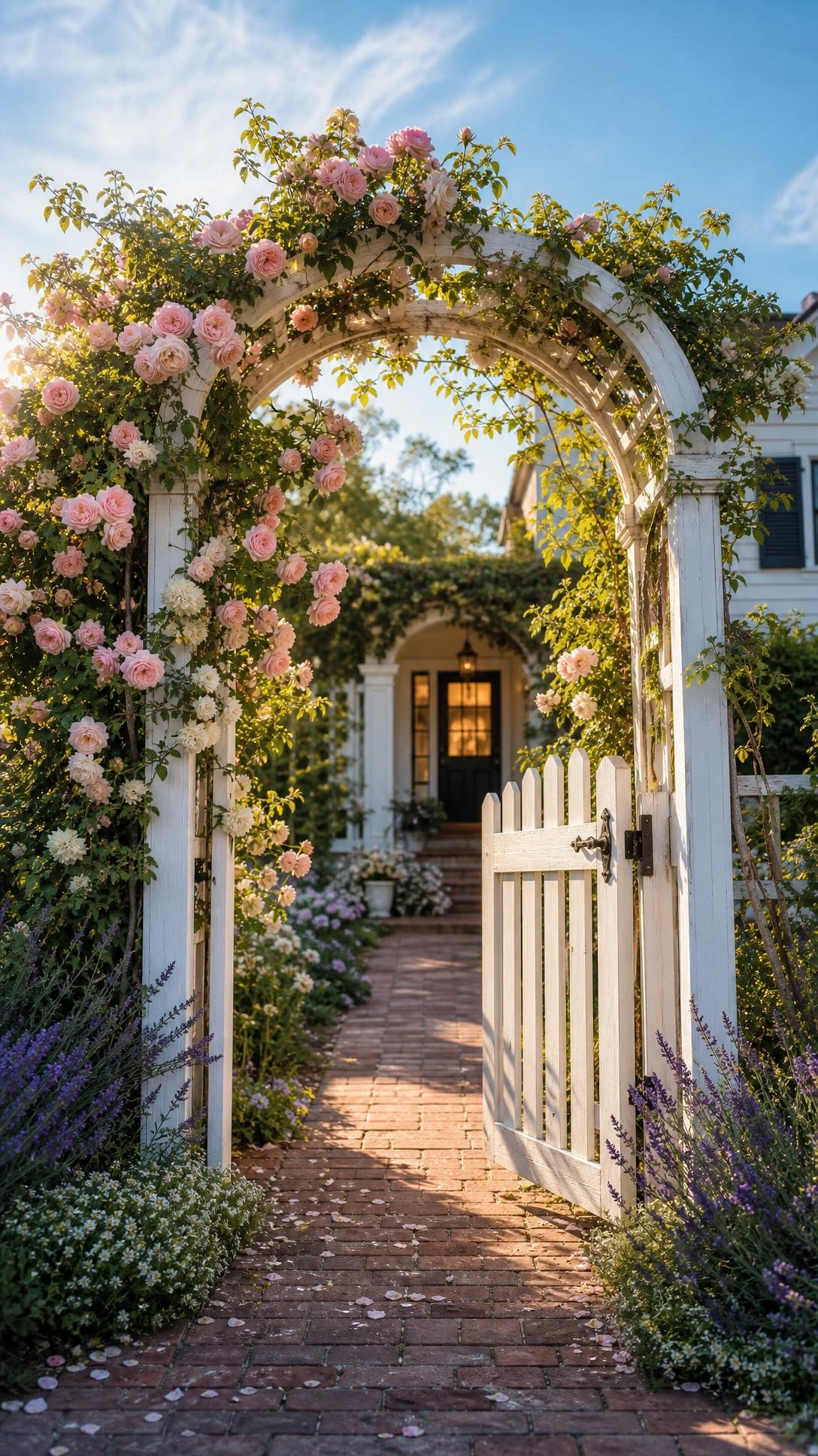
A simple arbor or garden gate at the start of the front walkway is one of those additions that people assume is too much, and then they see it on a real house and immediately understand why someone did it.
A white-painted wood arbor with a climbing rose like New Dawn or a clematis variety like Jackmanii growing over it turns the entrance to the walkway itself into a moment rather than just a transition from driveway to door.
The arbor does not need to be elaborate — a basic cedar arch in the 150 to 300 dollar range from a garden center already looks considered and deliberate when it is placed well and something is planted to grow over it.
This works best when the walkway is at least 30 to 40 feet long so the gate has room to function visually as a real entry rather than just something placed a few feet from the door.
Once the climbing plant fills in after a season or two, the whole thing looks like it has been there for years, which is usually exactly the feeling people are going for.
The Front Walkway Is Doing More Than People Realize
The path to the front door sets the tone for everything else about the house before a visitor is even close enough to notice the landscaping details.
Most of these ideas are completely doable on a weekend or across a couple of them, and none of them require tearing up the entire yard to make a real difference.
Starting with the material and the edge treatment usually makes the biggest visual change with the least amount of work — everything else is layered in from there.
A house with a thoughtful walkway just feels like someone cares about it, and that is honestly the whole point before anyone even knocks.

Hi, I’m Alizabeth, the creator of Pretty Home Hacks. I share practical home decor ideas, easy DIY projects, organization tips, and budget-friendly ways to make your home feel more beautiful and functional. From small room updates to everyday home hacks, my goal is to share approachable ideas you can actually use in your own space.